A Lesbian Elder Who Keeps Showing Up For Us
Lisa Hartouni has spent four decades photographing the people institutions overlook. She's also a lesbian elder this community owes real, ongoing support.
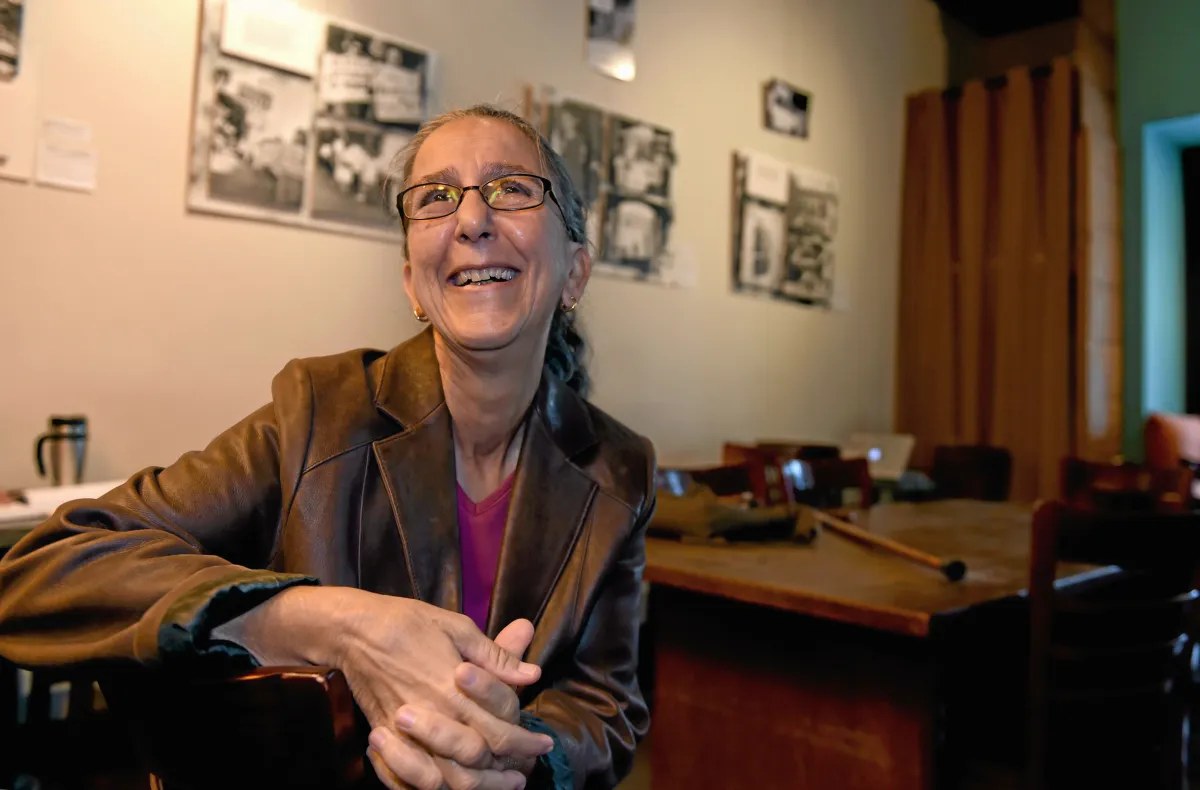
Lisa Hartouni is a lesbian elder, a Long Beach-based photographer, and — after more than four decades spent pointing a camera at the things institutions would rather people forget — someone this community now needs to show up for in return.
She came to photography sideways. Hartouni graduated from UCLA in 1980 with a degree in anthropology and sociology, then joined VISTA, the domestic Peace Corps, training as a community organizer. That work carried her into nearly two decades at the Pico Neighborhood Association in Santa Monica, where she was housing organizer, program developer, fundraiser, and administrator, often all in the same year. Somewhere in that stretch she picked up a camera and started freelancing as a news photojournalist, and it became a second calling. She doesn't so much photograph subjects as document relationships — the bond between people and their blocks, and the tension between communities and the institutions that press on them.
Her longest-running project, Intersections: Portraits of Neighborhoods, started in 2008 in Long Beach on a disarmingly democratic premise: hand cameras to the people who live somewhere — fifth-graders through college students — and let them document their own blocks, rather than imposing an outsider's eye on the work. It's moved through more than a dozen classrooms and found a home base at Hot Java, a Long Beach coffeehouse-turned-gallery. Since 2017, her other major series, From Here to Manzanar, has traced the WWII incarceration of Japanese Americans back to its local starting point at Terminal Island, where families were given as little as 48 hours to leave everything behind before being sent to the camp at Manzanar.
Underneath both sits an earlier archive: six black-and-white photo essays, shot between 1980 and the present and collected as My Photo Records — voting-rights organizing across Alabama's Black Belt in the late 1980s, LAPD abuse allegations from 1987 to 1992, immigrant detention at a converted Inglewood motel in 1987, and the generational housing crisis across Los Angeles. "I use photography as a tool to document," is how she's put it. Her work drew a Los Angeles Times review as early as 1993, a 2014 exhibit at Hot Java, and a 2015 "Amazing Women" finalist nod from the Long Beach Press-Telegram — recognition for work she was already doing as an organizer, long before anyone handed her a platform for it. She also runs a digital restoration practice, saving other people's deteriorating negatives, slides, and home VHS tapes before they're gone for good.
None of that has made the work financially sustainable, which is the part worth saying plainly. Hartouni is currently fundraising to expand her administrative capacity and secure fiscal sponsorship, so future support for her archive and preservation work can be tax-deductible — the unglamorous, practical work of making sure four decades of documentation outlives the moment it was made in. As a queer elder artist, her self-care and a sustainable income matter more than being expected to keep doing this work on exposure or goodwill alone. If you can, contribute here.
We're not writing this because we needed a reason to run her Classifieds listing (you can find that here — she's booking engagement shoots, small events, and headshots). We're writing it because elders like Lisa are the reason there's a "we" to write for at all, and that deserves more than a line item. You can see more of her work on Instagram @lisahartouni, with a new website on the way.
Support Lisa's work here:
GoFundMe: https://gofundme.com/f/help-sustain-lisa-hartounis-work
Instagram: https://www.instagram.com/lisahartouni
More from Visual Arts